


🎉 CANDY Project Successfully Completed! 🎉 We are pleased to announce that the final report of the CANDY project has been officially approved, marking the full completion of the project. Please see here our Final Publishable Summary of this Periodic Report. ...
Final Periodic Reporting successfully accomplished
🎉 CANDY Project Successfully Completed! 🎉
We are pleased to announce that the final report of the CANDY project has been officially approved, marking the full completion of the project.
Please see here our Final Publishable Summary of this Periodic Report.
Summary of the context and overall objectives of the project
Between 50 to 75 million children and adults in Europe suffer from early onset neurodevelopmental conditions (NDCs). These conditions affect the development of the brain. This may lead to altered brain structure and function that is associated with difficulties of social behaviour and communication, emotion, learning ability, and self-control. These conditions include autism, attention-deficit hyperactivity disorder (ADHD), Intellectual Disability (ID) and pose an enormous burden for patients and their families, and for society. This burden is due to the high prevalence, the lasting effects for a person’s lifetime, the overlap of these conditions with each other, and the frequent combination with somatic diseases such as epilepsy, allergies, immune and gastrointestinal diseases. Persons with these conditions die on average 20 years earlier than individuals in the general population. One main challenge is that there are no curative treatments for these conditions, and that our understanding of the underpinning pathophysiology is fragmentary. It was known that genetic factors play an important role in these conditions. The goal of CANDY is to improve our understanding of how the immune system, and the bacteria in the gut (microbiome) impact on these genetic factors. This will provide a novel conceptual framework to understand the pathophysiology of these conditions. The specific aims are 1) Elucidate the causal mechanisms that underlie these conditions and the combination with somatic disease 2) Deliver novel biomarkers to guide early diagnosis and targeted support subgrouping and/or treatment monitoring 3) Lay the groundwork for new strategies for prevention and treatment of neurodevelopmental conditions and epilepsy, and 4) Open-up new avenues for research. The project has provided several innovative tools such as a system for integrated measurement and analysis of animal behaviour and physiology, a translational test battery, a tablet task battery for preschoolers, and a whole suite of new statistical tools for the analysis of brain imaging data, and has launched a catalogue of clinical recommendations and guidance for the assessment of preschoolers with NDCs.
Work performed from the beginning of the project to the end of the period covered by the report and main results achieved so far
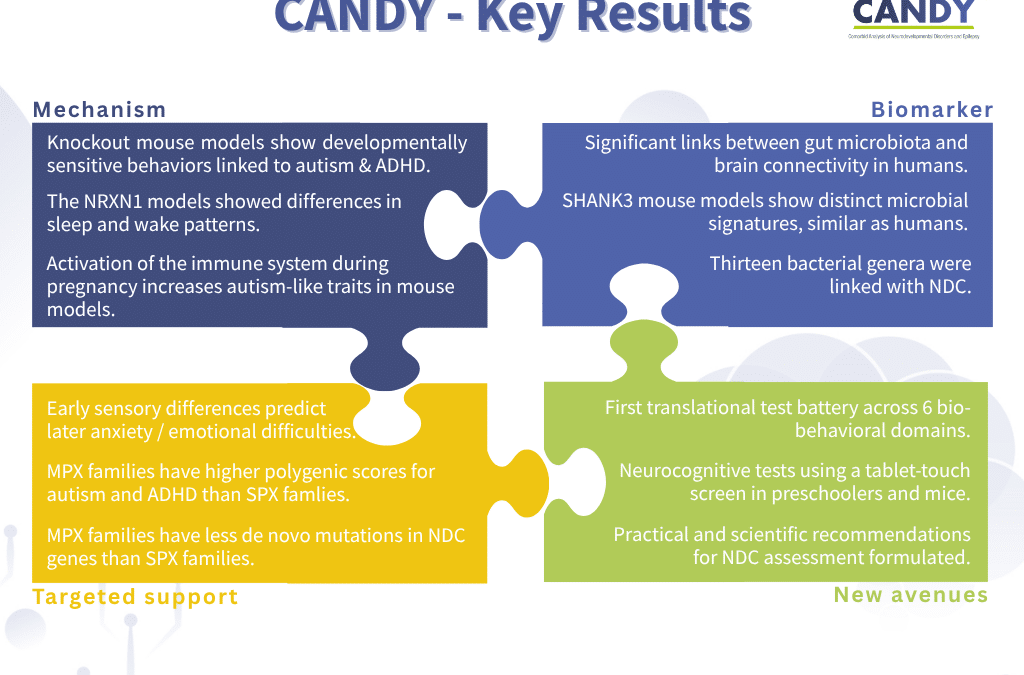
We have assessed sensory processing, behavioural phenotypes and EEG recordings in the NRXN1 and SHANK3 genetic mouse models at various development stages and performed behavioural profiling of PTCHD1 knock-out mice. The NRXN1 and SHANK3 models reveal different trajectories of sensory information processing deficits, which provides a basis to establish readouts for pathogenic pathways. Sensory hyperexcitability in NRXN-1 knock-out mice is associated with increased wakefulness that may be linked to disturbed circadian systems. In the SHANK3 model, we induced inflammation during pregnancy and found that this moderated the influence of genetic vulnerability on autism symptoms, confirming the two-hit model.
We completed work on a translational battery of tests that span six bio-behavioural domains (social processing, social/non-social reward, emotional reactivity, predictability, attention and executive functioning, and sensory processing). The tests have been matched conceptually and content wise for administration to mice and humans. The SHANK3 knock-out mice show altered social exploration, more anxiety, and greater sensitivity to unpredictable noise, and changes in the expression of NMDA and AMPA receptor subunits in the striatum in adulthood. We have also created a new set-up that combines physiological measures with behaviour in freely moving animals in complex behavioural tasks. The tablet test battery for preschoolers demonstrates good feasibility and psychometric properties and provides initial evidence of biological convergence in multivariate cluster analyses that showed meaningful associated with variation in brain structure and clinical variation in ADHD symptoms severity.
Our immune profiling work shows that potential immune-based clusters do not align clearly with diagnostic categories such as autism, ADHD, or ID. The analysis of the microbiome data shows that thirteen bacterial genera are robustly associated with the broader group of NDCs and a partially overlapping list of seven genera with autism. A meta-analysis compared the gut microbiota landscape between adults with ADHD and controls and found specific genera to be associated with ADHD. All these bacterial genera play a role in inflammatory processes.
The recruitment and data collection for wave-1 and wave-2 of the PIP-CANDY clinical study has been completed, with wave-3 data collection still ongoing. Quality control, preprocessing and data analyses are under way and working groups have formed to establish data-analytic and publication strategies for each data domain and across-domains. We successfully evaluated the efficacy of the novel AI tool, SynthSR that employs a convolutional neural network to enhance scan quality, effectively correcting motion artifacts within PIP preschool MRI scans.
The recruitment and data collection of the Multiplex clinical study has been completed, reaching the recruitment target of 104 Multiplex families. We have accomplished the whole genome sequencing of the families and made an operative list of genes associated with NDCs and conducted a large-scale study on more than 13,000 individuals with autism and 210,000 non-autistic individuals. We found several differences in the genetic architecture of NDCs between Simplex (SPX) and Multiplex (MPX) families such that de novo mutations in high confidence NDC genes were less frequently observed in MPX compared to SPX families. In contrast, MPX have higher levels of autism and ADHD polygenic scores compared to SPX families.
We have finalised OWEY v3 as a consortium-wide database and delivered multiple new statistical techniques as implementable and usable tools (extensions of the normative modelling approach; SPADE – Spatial Analysis for Discriminative Estimation; SupBigFLICA – semi-supervised and integrated estimation of multi-modal data with behavioural/clinical data; and SPADE-strat (multi-group stratification using SPADE).
Progress beyond the state of the art, expected results until the end of the project and potential impacts
CANDY’s results will have significant and immediate impact by giving new directions for clinical research to improve prevention, diagnosis, prognosis, treatment, and management of NDCs and their co- and multimorbidities. Research in CANDY has laid the groundwork for prevention of early maternal immune-activation, for new support strategies (immune-modulation/stem cells, or probiotics, nutrition; and/or identify new druggable targets) for NDCs (autism, ADHD, ID, and epilepsy). CANDY has identified developmental windows of opportunity for these interventions, and provide clinical recommendations for (early) diagnosis, targeted support of NDCs and their somatic multimorbidities. CANDY has delivered and tested biomarkers for (early) diagnostic, predictive, mechanistic and subgrouping purposes. To safeguard its legacy and maximize its impact on the scientific and professional community and society, CANDY has developed an effective and sustainable business and exploitation strategy.
 As part of the “Horizon 2020” programme, the European Commission is funding the five-year CANDY research project with a total of six million Euro under grant agreement No. 847818.