
Related Posts
Pagano J, Perez Arevalo A, Nosanova A, Bauer HF, Loth E, Andres S, Becker F, Otto M, Stefanoni A, Verpelli C, Oeckl P, Schön M, Boeckers T.
Transl Psychiatry. 2026 Mar 24;16(1):201. doi: 10.1038/s41398-026-03932-8.
ABSTRACT
Phelan-McDermid syndrome (PMS) is a relatively frequent cause of syndromic intellectual disability (ID) and autism spectrum disorder (ASD). It is typically caused by genetic alterations in the 22q13 chromosomal region, most often involving heterozygous deletions or mutations in the SHANK3 gene. More than half of affected individuals exhibit functional impairments in speech, cognition, motor skills, and behavior. Despite multiple ongoing therapeutic programs, objective and scalable liquid biomarkers to support patient stratification and to monitor disease course or treatment response are still lacking. Here, in a pilot study involving 23 individuals with PMS, we identified two biomarkers that are significantly altered compared to a control group and are associated with symptom severity. First, SHANK3 protein was detectable in peripheral blood mononuclear cells (PBMCs) and was markedly reduced in PMS (mean -77% vs. controls), consistent with SHANK3 haploinsufficiency; lower PBMC SHANK3 levels were associated with the presence of developmental regression, supporting its potential utility as a target-engagement/monitoring biomarker rather than a diagnostic screen. Additionally, plasma levels of beta-synuclein, a neuron-specific synaptic protein, were elevated in PMS and positively correlated with the severity of speech impairment. Both biomarkers were successfully back-translated in a Shank3 transgenic mouse model, where beta-synuclein levels were normalized through modulation of the mGlu5 receptor. Together, these results provide initial evidence for SHANK3 in PBMCs and plasma beta-synuclein as complementary liquid biomarkers to aid prognosis and enable objective monitoring of therapeutic response in PMS, warranting validation in larger and pediatric longitudinal cohorts.
PMID:41876457 | PMC:PMC13039877 | DOI:10.1038/s41398-026-03932-8


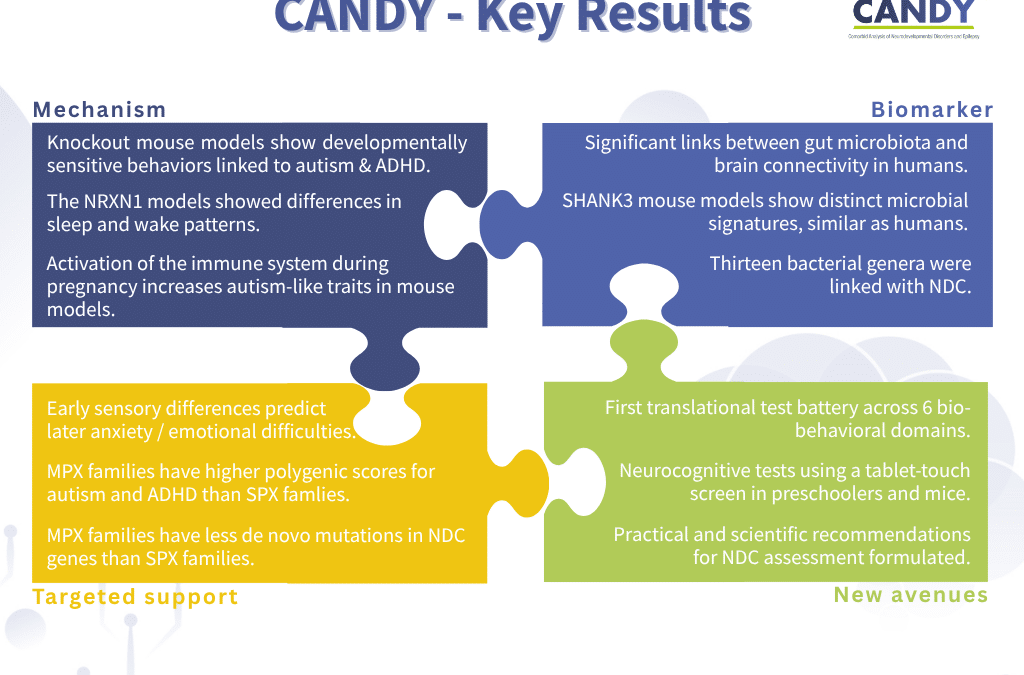
 As part of the “Horizon 2020” programme, the European Commission is funding the five-year CANDY research project with a total of six million Euro under grant agreement No. 847818.