
Related Posts
-
Shank3 related muscular hypotonia is accompanied by increased intracellular calcium concentrations and ion channel dysregulation in striated muscle tissue
-
Comparison of SHANK3 deficiency in animal models: phenotypes, treatment strategies, and translational implications
-
Large-scale analysis of structural brain asymmetries during neurodevelopment: Associations with age and sex in 4265 children and adolescents
Avramiea AE, Juarez-Martinez EL, Garcés P, Hipp JF, Poil SS, Diachenko M, Mansvelder HD, Jones E, Mason L, Murphy D, Loth E, Oakley B, Charman T, Banaschewski T, Oranje B, Buitelaar J, Bruining H, Linkenkaer-Hansen K.
Sci Rep. 2026 Apr 3. doi: 10.1038/s41598-026-42120-y. Online ahead of print.
Qualitative EEG abnormalities are common in Autism Spectrum Disorder (ASD) and hypothesized to reflect disrupted excitation/inhibition (E/I) balance. To test this, we recently introduced a functional measure of network-level E/I ratio (fE/I). Here, we applied fE/I and other EEG measures to alpha oscillations from source-reconstructed data in the EU-AIMS dataset (267 ASD, 209 controls). We analyzed these measures alongside qualitative EEG abnormalities ranging from slowing of activity to epileptiform patterns, aiming to replicate the findings from the SPACE-BAMBI study. Contrary to our previous report, we did not observe increased fE/I variability in ASD compared to controls. EEG abnormalities were rare in adults and could not be statistically assessed. ASD children-adolescents with EEG abnormalities exhibited lower relative alpha power and fE/I compared to those without. However, EEG-abnormality scoring did not stratify the behavioral heterogeneity of ASD using clinical measures. Surprisingly, several controls also exhibited qualitative EEG abnormalities with a strikingly similar anatomical distribution of reduced fE/I, reflecting inhibition-dominated network dynamics in sensory processing regions. The robustness of this association between EEG abnormalities and reduced fE/I was further supported by re-analysis of the SPACE-BAMBI study in source space. Stratification by the presence of EEG abnormalities and their effects on network activity may help understand neurodevelopmental physiological heterogeneity and the difficulties in implementing E/I targeting treatments in unselected cohorts.
PMID:41932958 | DOI:10.1038/s41598-026-42120-y


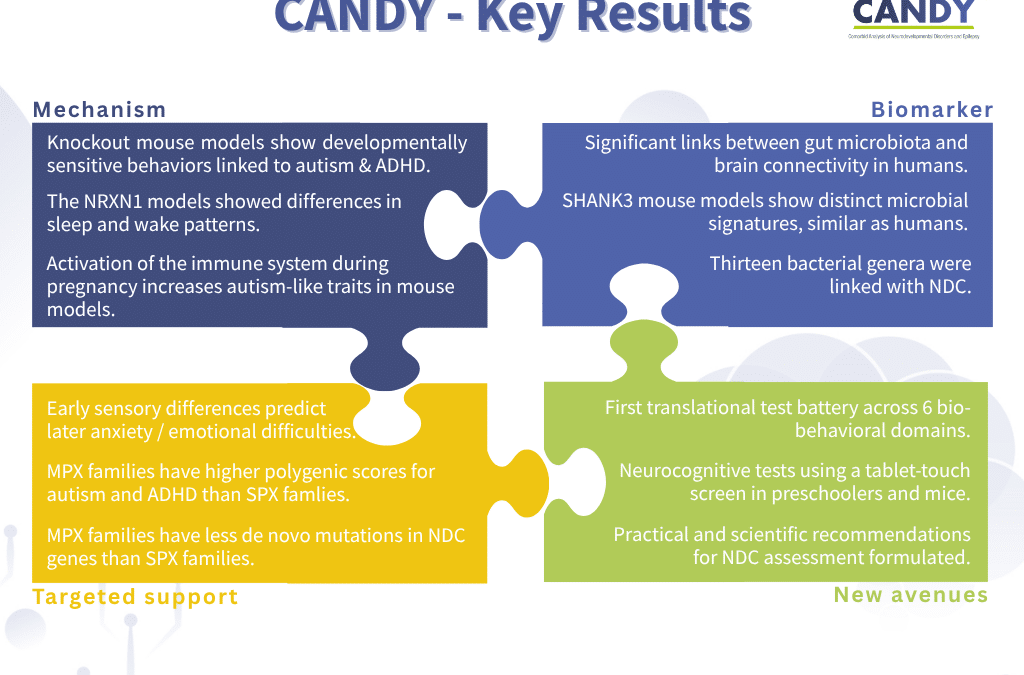
 As part of the “Horizon 2020” programme, the European Commission is funding the five-year CANDY research project with a total of six million Euro under grant agreement No. 847818.