
Valid animal models that take a developmental perspective and inform about causal mechanism
CANDY has deepened our understanding of the three animal models studied, the NRXN1, SHANK3, and PTCHD1 knock-out model, of their relevance as models of autism and ADHD.
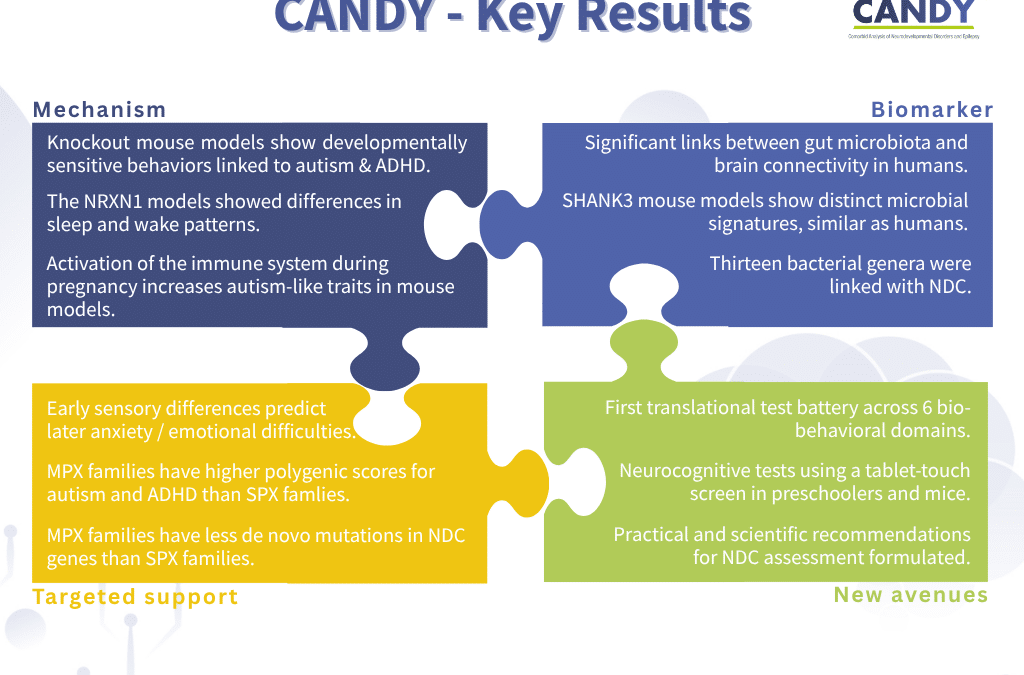
- NXRN1 and SHANK3 models reveal different trajectories of sensory information processing deficits.
- NRXN1 models revealed altered sleep-wake distribution, and a progressive change in the level of excitability as function of age.
- Immune activation during pregnancy Intensifies/increases Autism Spectrum condition related alterations in Shank3 Mouse model.
- PTCHD1 model exhibits behavioral alterations but no observable changes in neuronal cholesterol distribution
Results are published – please check our CANDY publications
Create, validate and deliver the first translational battery for Neurodevelopmental Conditions
CANDY has developed, tested and delivered a translational battery for Neurodevelopmental Conditions that allows translation from human data to animal models and from animal models to human data. The preclinical and human components are linked by matching tests that span six bio-behavioural domains: social processing, social/non-social reward, emotional reactivity, predictability, attention and executive functioning, and sensory processing.
| Domain | Mice | Human |
| Emotional reactivity | elevated plus maze test (EPM) | |
| Predictability | elevated plus maze test (EPM) while being exposed to (un)predictable sounds | |
| Executive functioning | Reinforcement learning task | |
| Sensory processing | Prepulse inhibition | Not assessed |
| Social reward | Social reward test | Social reward test |
| Social processing | Ultrasonic vocalizations |
Part of the translational battery is a battery of neurocognitive tests using a tablet-touch screen format in preschoolers with NDCs and TD preschoolers. This battery provides a unique set of tools that will further serve research on the neurocognitive and biological understanding of NDCs.
For protocols, SOPs and codes needed for testing and data analyses, please contact:
Prof Judith Homberg, Radboud Medical Center:
Prof Eva Loth, King’s College:
Associations between immune signatures, inflammation and microbiome in Neurodevelopmental Conditions
CANDY has generated and analyzed extensive datasets integrating immune proteomic and genetic markers in children with NDCs, complemented by parallel animal model studies. These studies provide new insights into the complex relationships between the immune system, inflammation, and brain development, laying the foundation for precision approaches to understanding NDCs.
- Immune genetics: Analyses of >100 immune-related genes, including HLA and immune receptor loci, revealed variants that may influence susceptibility to NDCs. These preliminary associations require confirmation in larger datasets.
- Immune proteomics: Analyses of >100 circulating immune and brain-gut markers, adjusted for age and sex, showed distinct immune activity patterns across conditions: higher levels in ADHD, lower in ASD, and broad downregulation in epilepsy.
- Multivariate immune profiling: Advanced analyses revealed that immune variation is distributed across multiple axes, and that clusters based on immune profiles did not align clearly with diagnostic categories, suggesting biological diversity beyond clinical labels.
- Animal models: In ASC-like mouse models (NRXN1 and SHANK3), both age and sex effects were observed. Several inflammatory proteins changed with development or between sexes, highlighting developmental and sex-linked influences on immune activity.
Although preliminary, these human and murine findings illustrate the potential of immune profiling to define biologically meaningful subgroups within NDCs and to bridge molecular and behavioural dimensions of neurodevelopment.
Scientific papers summarizing these findings are in preparation and will be shared through the CANDY publications once available.
CANDY has contributed significantly to the understanding of whether the microbiome structure differs between individuals with Neurodevelopmental Conditions and non-autistic individuals.
- Thirteen bacterial genera were found to be robustly associated with NDCs and a partially overlapping list of seven genera with Autism-Spectrum-Conditions.
- SHANK3 mouse models are associated with distinct microbial signatures, converging with the human findings.
Although preliminary, these murine and human findings illustrate the potential of immune proteomics to define biologically meaningful subgroups within NDCs.
Please check CANDY publications
Clinical research platform – longitudinal multi-centre preschool study (PIP/PIP-CANDY) of autistic and non-autistic children
CANDY has extended a unique longitudinal study, the Preschool Imaging Project (PIP/ PIP-CANDY ) that was designed to fill the gap between studies in very young children (below 3 years) at elevated risk for ASC and related NDCs, and studies in children (6 years and older), adolescents and adults with ASC. CANDY has extended the design by recruiting preschoolers with ADHD and ID/DD.
- While data collection of wave-2 and wave-3 is still ongoing, CANDY has established the necessary data base infrastructure to analyze the longitudinal preschool data set, and has set up a comprehensive conceptual and methodological data analytic framework.
- First data analyses observed: a) associations between early differences in sensory processing and later anxiety and other emotional symptoms b) differing trends in increasing or decreasing ADHD severity from wave-1 to wave-2.
For PIP/PIP-CANDY cohort information, please contact Prof Eva Loth, King’s College:
Human genomics to discover shared vs distinct genetic risk factors and molecular pathways
CANDY’s work on the genomics of NDCs has taken a comprehensive perspective that involves the analysis of the genetics of the clinical cohorts in CANDY (CANDY-PIP and CANDY-MPX), combined with the analysis of the clinical cohorts of AIMS-2-TRIALS (PIP and LEAP), the French InovAND cohort, and the international SPARK cohort.
Whole genome sequencing of the CANDY-MPX study and of the PIP and CANDY-PIP participants has been conducted and differences in the genetic architecture of NDCs between SinglePleX and MultiPleX families have been detected:
- de novo mutations in high confidence NDC genes were less frequently observed in MPX compared to SPX families
- MPX families have higher levels of autism and ADHD polygenic scores compared to SPX families
A database that lists genes associated with NDCs has been developed: https://genetrek.pasteur.fr/
The CANDY genomics resource will be shared with the scientific community and constitutes a basis for ongoing and future analyses that will increase insights in the shared and distinct genetic factors that underlie different NDCs.
For MPX study and human genomics, please contact Prof Thomas Bourgeron, Institute Pasteur:
Develop and implement new approaches to data analyses
CANDY has successfully develop and implement advanced statistical tools and data-analytic methodologies to enable robust, multimodal characterisation of neurodevelopmental disorders (NDCs) and their comorbidities. CANDY created tools designed to handle large, heterogeneous, and multi-site datasets, ensuring reproducibility, scalability, and compliance with ethical and legal frameworks. The developed methodologies have been validated across datasets within CANDY and benchmarked in international consortia, demonstrating both their scientific and translational utility. Approaches include:
- Imputation Strategies
- Normative Modelling
- Linked ICA and Multimodal Data Fusion
- SPADE and Tangent-Space Functional Fingerprinting
- Hierarchical Spectral Clustering
- Utility Demonstrated in the Literature
Please check CANDY publications
For information on statistical tools and data-analytic methodologies, please contact Prof Christian Beckmann, Radboud University Medical Center:
Identify risk, stratification, and prognostic biomarkers in NDCs and their multi-morbidities
CANDY has significantly contributed to identify new markers that allow biologically more homogeneous subgrouping, identify markers that reflect risk to develop an NDC, and markers that indicate different developmenmtal trajectories of NDCs.
- Linked Independent Component Analysis was applied to structural MRI, diffusion imaging and resting-state fMRI data,showed reduced grey matter in the anterior cingulate cortex and insula, coupled with white matter alterations in the superior longitudinal fasciculus and corpus callosum in Autism-Spectrum-Condition individuals.
- Neurodevelopmental Conditions may involve altered relationships between functional brain organisation (how regions are connected in resting state) and structural connectivity:
- Altered functional organisation of the superior temporal sulcus and fusiform gyrus, regions implicated in social perception, alongside structural alterations in long-range tracts such as the inferior longitudinal fasciculus and uncinate fasciculus. This multimodal signature was significantly associated with social communication difficulties.
Ongoing and future work will extend this type of analyses to the longitudinal data of the LEAP and PIP/ PIP-CANDY cohorts.
Please check CANDY publications.
For information on subgrouping analyses, please contact Prof Christian Beckmann, Radboud University Medical Center:
For PIP/PIP-CANDY cohort information, please contact Prof Eva Loth, King’s College:
For LEAP cohort information, please contact Jan K. Buitelaar, Radboud University Medical Center:
Clinical Guidance and Recommendation
A workgroup within CANDY, consisting of the clinicians of the clinical study sites and representatives of ADDISS, ADHD-Europe and Autism Europe, has successfully developed a catalogue of clinical recommendations and guidance for the assessment of Neurodevelopmental Conditions with a focus on the preschool age.
The document gives:
- practical guidance, focusing on clinical personnel, testers and clinicians working with the children in assessment settings to iprove clinical care.
- scientific recommendations, focusing on burning questions in the research field and research knowledge gaps to improve diagnostic/supportive approaches.
The document is currently prepared for being published.
For information, please contact Prof Jan K. Buitelaar, Radboud University Medical Center:
Developed commercial tools for animal behaviour analyses
1.) System for integrated measurement and analysis of rodent behaviour and physiology (Noldus)
Description: This system combines the data acquisition and analysis capabilities of a video tracking system (EthoVision XT) and a telemetry system (TSE Stellar), enabling the concurrent measurement and integrated analysis of a rodent’s locomotion, body posture or behavioral pattern, and physiology.
The tool is commercially available
2.) System for analysis of complex social interactions in rodents (Noldus)
Description: This system combines technologies for multi-animal tracking with software for analysis of social interactions in groups of up to four rodents (rats or mice).
The combination of Live Mouse Tracker (Institut Pasteur) and EthoVision XT 17.5 software is already commercially available: https://noldus.com/newsroom/pasteur-live-mouse-tracker.
3.) PhenoTyper 2
Description: In the course of the CANDY project, Noldus has developed a major upgrade of the PhenoTyper, its instrumented observation cage for continuous, automated behavioural monitoring of mice or rats. The main innovation is the replacement of the analogue top unit with preconfigured integrated electronics by a digital top unit with a modular design, offering sockets with embedded power and communication lines for up to nine sensors and stimulus devices. These include different types of cameras, ultrasonic microphones, light and sound stimuli, etc. The new system has been validated by RadboudUMC.
The tool is commercially available.
4.) UltraVox XT 4
Description: New tool for recording and analysis of ultrasonic vocalizations in rodents. This tools has been developed by Noldus as an extension of its system for integrated measurement and analysis of rodent behaviour and physiology. Rodents’ vocal communication is an important element of their phenotype, so adding the measurement of ultrasonic vocalizations is a logical next step in the development of a holistic tools suite for preclinical studies with rodent models of NDCs.
The tool is commercially available
5.) SmartAnnotator
Description: Computer vision and AI-based automated observation of rodent behaviour has come a long way but there are still instances where the system is unable to categorize the behaviour conform the classed that human experts have agreed on. Noldus is developing the SmartAnnotator to fill that gap. It is novel tool for behavioral annotation and analysis that combines the power of AI with that of a human observer, allowing the human expert to add the missing pieces in the behavioural observation while training the AI model at the same time.
Commercial launch is planned for Q2/2026


 As part of the “Horizon 2020” programme, the European Commission is funding the five-year CANDY research project with a total of six million Euro under grant agreement No. 847818.